Why KPIs Should Be Viewed as an Operational System, Not Independent Metrics
Written by: Andrew Wright — Regional Director, One Source Hearing
In 2009, Domino’s Pizza was struggling.
Their stock price had collapsed to roughly $5 per share and like many struggling businesses, leadership focused heavily on downstream financial outputs:
- Total Revenue
- Comparable Store Sales
- Margins
To improve those numbers, they did what most companies do when growth slows:
- Increased ad spending
- Leaned heavily into discounts and promotions
- Pushed stores to sell more pizzas
It failed.
Then, new CEO Patrick Doyle recognized something many businesses overlook:
Revenue is rarely improved directly. It is typically the downstream result of operational systems functioning correctly upstream.
If the output KPIs were going to improve, Doyle needed to identify the upstream behaviors driving those numbers in the first place.
One major insight emerged:
When delivery times became too long, repeat ordering behavior dropped dramatically.
At first glance, that may sound obvious, but the important part is what happened next.
Instead of continuing to obsess over revenue itself, Domino’s traced the problem further upstream until they identified a highly influential operational behavior:
The time elapsed between a customer clicking “Order” and the pizza entering the oven.
This became known internally as “load time.”
And while load time may sound insignificant, they realized it was a highly significant KPI that ultimately influenced the entire system:
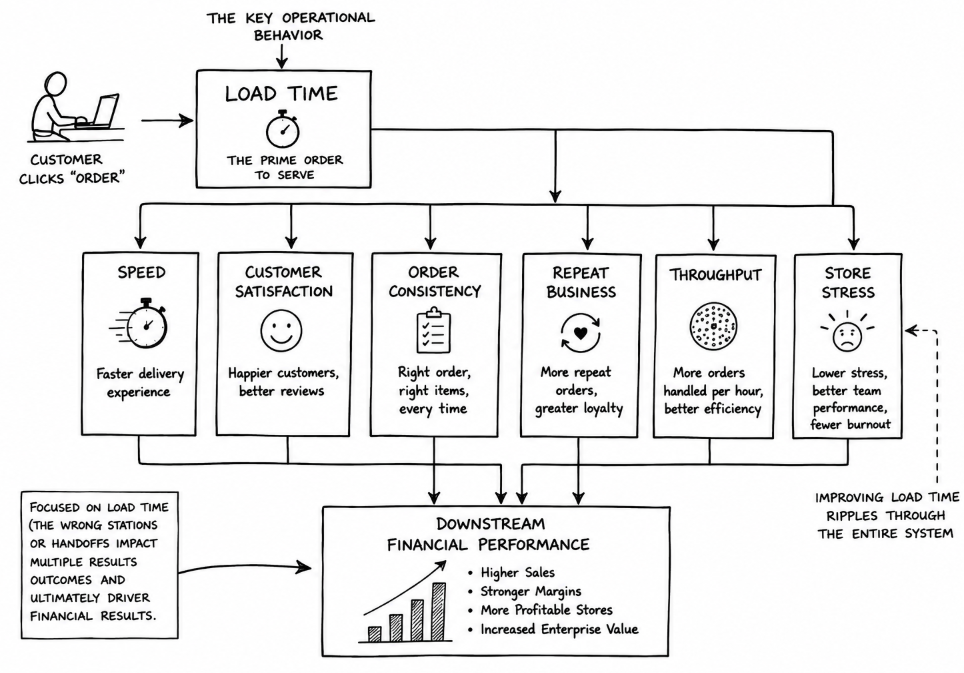
One leading KPI was not the singular driver of Domino’s historic turnaround. The company also reinvented its recipe, overhauled marketing, accelerated e-commerce, and strengthened execution across the business.
But load time represented something larger: Domino’s stopped managing the scoreboard and started managing the system creating the scoreboard.
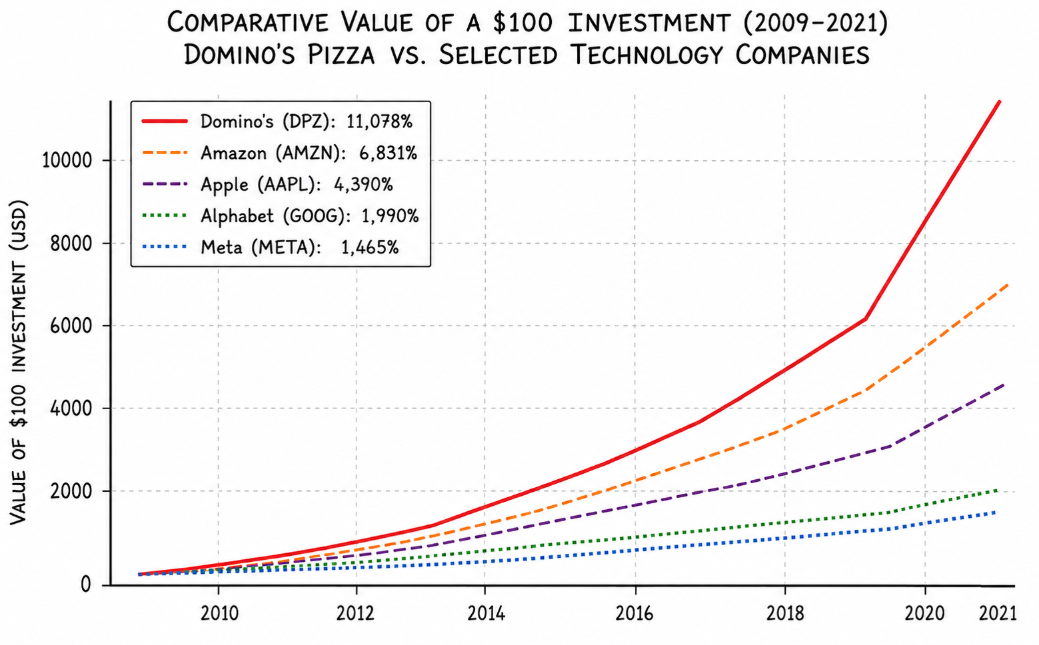
Over the next decade, Domino’s experienced one of the most remarkable corporate turnarounds in modern business history — outperforming Amazon, Apple, Meta, and Alphabet between 2010 and 2020.
The reason I bring this up is because most KPI conversations inside hearing healthcare completely miss this distinction.
The lesson from Domino’s wasn’t that load time was a magical KPI. The lesson was that performance improved when leadership stopped asking, “How do we increase revenue?” and started asking, “What operational factors are creating our revenue in the first place?“
That may sound like a small difference, but it fundamentally changes how we approache performance improvement. Rather than focusing on outcomes, the focus shifts to understanding the system producing those outcomes.
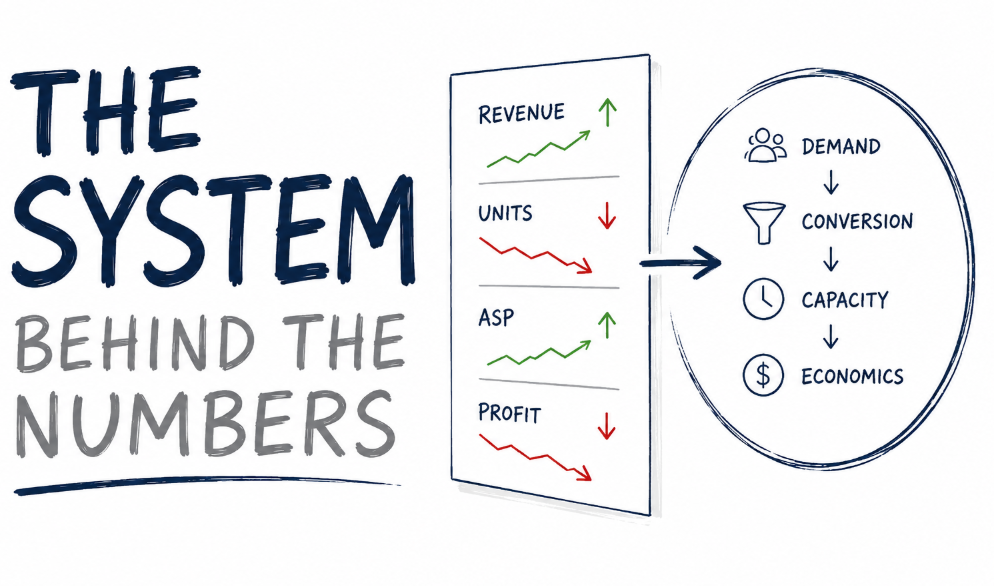
- Revenue is down? Maybe we need more marketing.
- Unit sales are down? Perhaps we should focus on sales training.
- Profitability is down? Let’s see if we can reduce our hearing aid costs.
None of those are inherently wrong, but we often jump to solutions before understanding which part of the system is actually underperforming. A decline in revenue, units, or profitability, may have very little to do with marketing, sales training, or hearing aid costs.
The challenge is that most business outcomes are influenced by multiple factors simultaneously. When we focus on the outcome alone, we risk treating symptoms rather than identifying causes.
Let’s use revenue as an example. Revenue is not a standalone event.
Revenue is produced when potential patients enter the practice, providers successfully convert those patients into treatment, sufficient capacity exists to serve demand, and the economics of the business support profitable growth.
In other words, revenue is not a system. It is the result of a system.
One way to make sense of all these moving pieces is to view a practice through four primary systems. Most KPIs ultimately belong to one or more of them.
Some metrics sit almost entirely within a single system, while others exist at the intersection of multiple systems. Regardless of the metric, understanding which system it belongs to often provides more insight than the number itself.
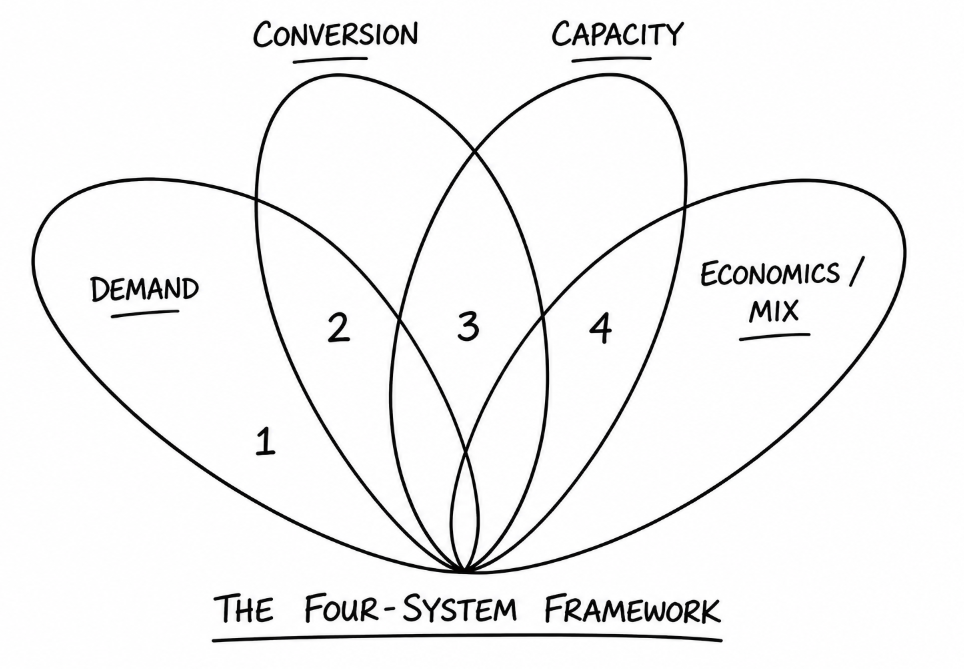
The purpose of this framework is not to classify KPIs. It’s to better understand how performance is created.
While every practice is unique, these four systems collectively explain most of what owners ultimately care about: revenue, units, ASP, profitability, growth, patient access, and long-term sustainability.
The mistake most of us make is assuming these outcomes operate independently.
They don’t.
A practice can have strong demand but insufficient provider capacity.
A practice can have great patient flow but poor conversion.
A practice can improve conversion while simultaneously damaging profitability.
A practice can lower hearing aid costs while doing nothing to address the actual constraint limiting growth.
The outcomes we see on a dashboard are rarely the product of a single KPI. They are the result of multiple systems interacting with one another.
When performance begins to slip, the instinct is to ask: What KPI should we improve?
Perhaps the better question is: What system requires attention?
The goal isn’t to improve a number. The goal is to improve the system producing that number.
In the next article, we’ll explore the different types of KPIs and why not all metrics serve the same purpose. Understanding the role a KPI plays within a business is often more important than the KPI itself.

Andrew Wright – Regional Director
One Source Hearing